Jamie London Clay is an Identity Reconstruction Guide, teacher, and singer, and the daughter of Tim “Awesome” Austin. She writes about identity, legacy, and rebuilding at jamielondonclay.com.
Remembering Tim “Awesome” Austin: The Drummer Who Never Got His Flowers
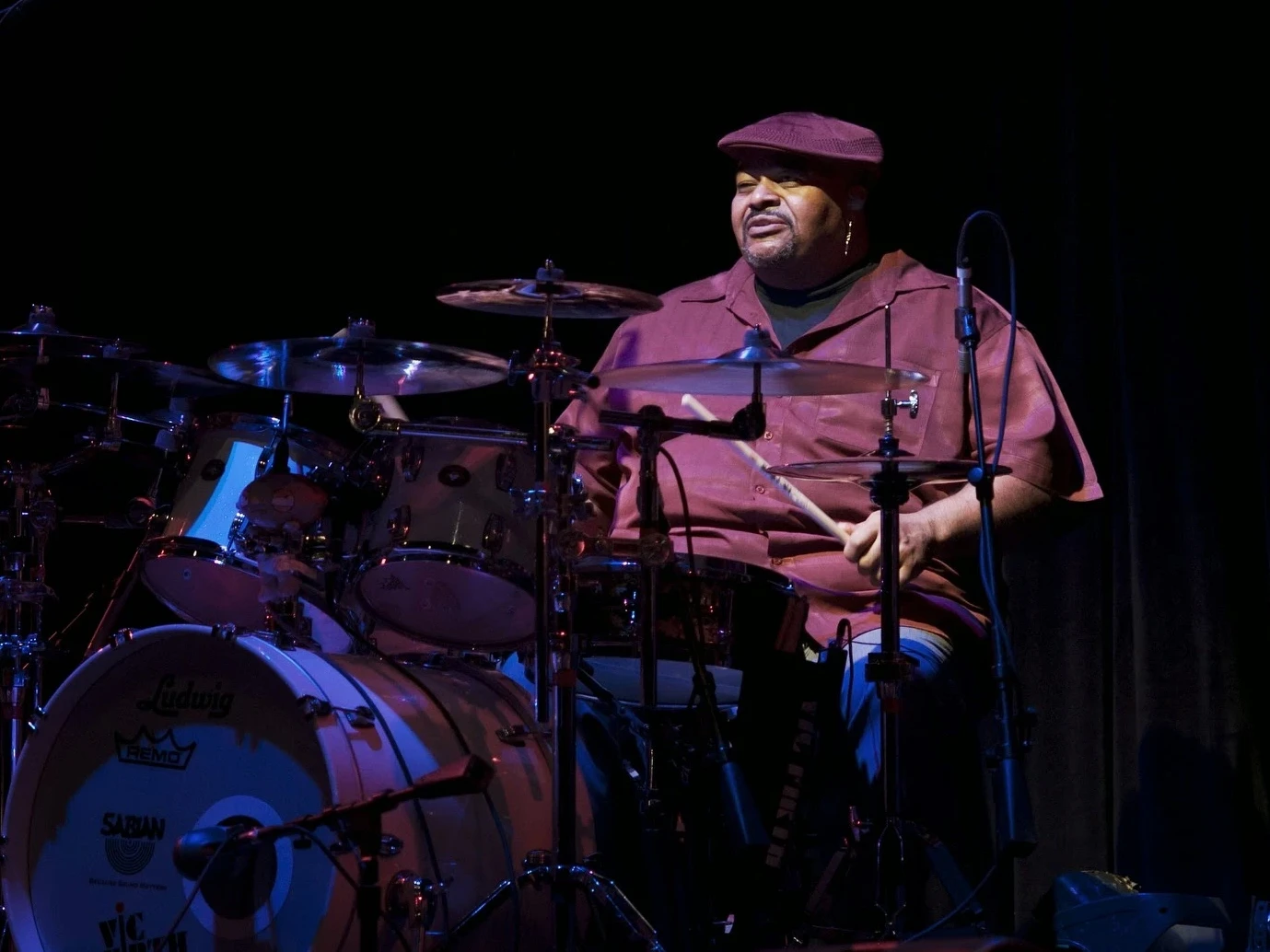
My father, Timothy Terrell Austin, was known to the world as Tim “Awesome” Austin, the drummer who anchored the Staple Singers for 25 years and Buddy Guy’s Damn Right Blues Band for more than 15 years after that. This October 6 would have been his 70th birthday, and the biggest thing he ever gave me wasn’t rhythm. It was a warning about the business side of this industry, and a book to make sure I never learned that warning the hard way.
The Heartbeat Behind the Music
Timothy Terrell Austin was born October 6, 1956, and passed away April 3, 2019. In between, he became the heartbeat, literally, of two of the most respected outfits in American blues and soul. He auditioned for the Staple Singers at nineteen years old and stayed 25 years, rising to become the band’s musical director. From there he anchored Buddy Guy’s Damn Right Blues Band for more than 15 years, having just marked that 15th year with the band the June before he passed. Buddy Guy, the multiple-Grammy-winning, Rock and Roll Hall of Fame guitarist, called him the heartbeat of that band, and I carry that sentence the way other people carry a diploma.
He taught himself before he ever owned a real kit, banging on paint cans and tree branches as a kid, chasing the feeling he got watching James Brown and Jackie Wilson work a crowd. He didn’t get his first real drum set until 1964. Everything after that, he built himself.
He had a saying that summed up how he approached this as work, not just art: “if you payin’, I’m playing.” Take the gig, do the job, get paid. That was survival as much as it was pride, decades of steady work instead of waiting around for only the biggest rooms. And underneath the hustle was something that never changed: he wanted to make people feel good. That was always the actual point for him.
I am so proud of this man it’s taken me until now to actually write it down.
Before He Was Anyone Else’s Heartbeat
Yes, and this is the part of his story I almost left out because it isn’t the part that made headlines, but it’s the part that shows he wasn’t only ever standing behind someone else. In 1977, my father co-founded The Wrecking Crew, a nine-piece Chicago funk and soul band built around musicians from the Staple Singers’ own rhythm section, not to be confused with the famous Los Angeles studio players who used the same name. He was the drummer and one of the group’s vocalists, alongside Nicholas Toler Williams on lead guitar and Jack Chatman on bass, backed by a full horn section. They released a handful of singles in the early 1980s on the Ercet and Sound of Florida labels before the group disbanded in 1983.
It never made him famous. But it means that before he was anyone else’s heartbeat, he was already leading his own band, singing lead, standing at the front of a stage he built himself. That’s not a footnote to me. That’s the part of him I recognize the most.
The Rooms Where the Real Ones Know
He backed two Rock and Roll Hall of Fame inductees, B.B. King and Eric Clapton, on top of everything else, and he took a paint-can drummer from the South Side of Chicago onto stages across the world. He played the Experience Hendrix Tour as a second drummer alongside Stevie Ray Vaughan’s own drummer, Chris Layton, sharing that stage as an equal with one of the most respected drummers in the business. With Buddy Guy’s band he played the North Sea Jazz Festival in Rotterdam, the Netherlands, documented there in both 2010 and 2016, and that is one stop among the international touring that came with the job.
He shared stages and studios with a long list of Chicago blues royalty: Otis Rush, Eddie “The Chief” Clearwater, Luther Allison, James Cotton, Junior Wells, John Mayer, Carlos Santana, Warren Haynes, Sugar Blue, Billy Branch, and Joanna Connor, among many more. His playing was trusted enough that Ludwig Drums, SABIAN Cymbals, Vic Firth Drumsticks, and Remo Drumheads all endorsed him.
In 2016 he was featured in Modern Drummer magazine, issue 345. So he did get some of his flowers, in the rooms where drummers actually know who the real ones are. What he didn’t get was your kind of recognition, the kind where a stranger hears the name and already knows who you’re talking about. That gap between industry respect and public recognition is exactly what this article is naming.
The Book He Put In My Hands
He taught me that talent without business knowledge is a gift standing unprotected. My father never finished high school, and by his own account, he didn’t always use what he knew about this business as well as he could have. So instead of pushing me toward the stage, which is what I actually wanted, he put a book in my hands and made me read it cover to cover: All You Need to Know About the Music Business, by Donald Passman.
That book breaks down the parts of this industry most working musicians never get taught: how record deals and contracts are actually structured, how songwriters and publishers get paid, how streaming changed the way artists earn and where their leverage actually is now, what a manager’s cut should look like versus an agent’s, and how artists today can reach an audience without waiting on a label’s permission at all. My father wanted me to understand the deal before I ever signed one, the royalty statement before I ever depended on one, the difference between owning your masters and just performing on somebody else’s.
His actual working philosophy was “if you payin’, I’m playing.” A little money was better than no money, so take the gig, that’s what kept him working steadily for decades instead of sitting around waiting for only the biggest rooms to call. I inherited that instinct. But running my own business now, I’ve had to refine it past where he left it: sometimes the little bit of money isn’t worth what it costs you in time, and time is often the more expensive thing to lose, more than whatever that small paycheck was actually worth. That’s not me rejecting what he taught me. It’s what I built on top of it.
If I’m honest, part of me still wishes he’d let me chase the stage the way I wanted to instead. But I understand him completely now. He’d lived what happens to a gift with no business sense protecting it, and he was not going to let that happen to me. That is what I actually inherited from him. Not just rhythm. The understanding that your gift only holds up if you protect the business standing under it, and that losing track of your own worth is never just a music industry problem, it’s how people lose themselves altogether. It’s the same truth I teach now through identity reconstruction work.
Never Got His Flowers
Because this industry hands the headlines to whoever’s standing out front and lets the heartbeat stay invisible behind them, no matter how essential that heartbeat actually was. He got real respect where it counts, a magazine feature, festival bills, the trust of legends. What he never got was the wider public knowing his name the way they know the names of the people he stood behind. My father was one of the best there ever was in this business, and I know that not just because I’m his daughter. Musicians who worked next to him still stop me, unprompted, to tell me he was one of the most authentic players they ever shared a stage with.
We had our years of distance before we ever had our years together, and I won’t relive all of that here. What I will tell you is I got twenty good years with him before he passed, and I don’t take one single one of them for granted. (I’ve written this same kind of tribute for his parents, my paternal grandparents, too: In Loving Tribute, William James Austin, Black Korean War Veteran, and The Day I Buried My Grandmother.)
He is missed, not just by me, but by every musician and every fan who ever got close enough to see what he actually built. So today, on his birthday, I’m putting his name where it can be found and kept. Not the heartbeat behind somebody else’s headline. His own name. My father’s name.
What I’d Hand You, the Way He Handed It to Me
If you take one thing from this article and you’re a musician, a singer, or anyone building a creative career, it’s this: read the business before you need to. All You Need to Know About the Music Business is the exact book my father put in my hands, and it’s still the one I’d hand you.
AFFILIATE LINK NEEDED AMAZON_BOOK_LINK.
And if you want to actually hear what my father helped build, go listen to the music. Buddy Guy’s Damn Right Blues Band. Otis Rush. Luther Allison. James Cotton. Carlos Santana. Warren Haynes. Every one of them is part of this same story.
AFFILIATE LINK NEEDED Insert your Amazon affiliate links for Buddy Guy, Otis Rush, Luther Allison, James Cotton, Carlos Santana, and Warren Haynes albums/catalogs here
Frequently Asked Questions
Was Tim Austin famous?
Inside the blues and soul industry, yes, at the highest level. To the wider public, no, which is exactly the imbalance this article is naming. He spent 25 years as the Staple Singers’ musical director, more than 15 years anchoring Buddy Guy’s Damn Right Blues Band, backed Rock and Roll Hall of Famers B.B. King and Eric Clapton, played the Experience Hendrix Tour as a second drummer alongside Chris Layton, played international stages including the North Sea Jazz Festival in the Netherlands, and was featured in Modern Drummer magazine in 2016.
Did Tim Austin have his own band?
Yes. In 1977 he co-founded The Wrecking Crew, a nine-piece Chicago funk and soul band, and released singles on the Ercet and Sound of Florida labels before it disbanded in 1983. This is separate from the well-known Los Angeles Wrecking Crew studio musicians of the same name.
What band was Tim Austin in?
He auditioned for the Staple Singers at nineteen and spent 25 years with them, rising to musical director, co-founded his own Chicago band, The Wrecking Crew, in 1977, then went on to anchor Buddy Guy’s Damn Right Blues Band for more than 15 years and perform on the Experience Hendrix Tour as a second drummer alongside Chris Layton.
What’s the best book to learn the music business?
All You Need to Know About the Music Business by Donald Passman is the one working musicians and industry professionals point to most often, and the one my own father insisted I read. It covers deal structures, royalties, publishing, streaming economics, and how artists can build independent careers today.
What I Do With What He Gave Me
If any part of his story sounds like your own inheritance, the parts you’re still learning to protect, start with the book above. And if you want to hear the other side of what I do with what he gave me, stream Freedom Love, buy it, and share it with somebody who needs it.
Stream it on Spotify or Apple Music. Buy it on Bandcamp or Amazon Music. Or start on my own page right here on the blog, where all of it lives in one place.